Every great food has a story, and biltong’s is one of the best. What began as a survival technique for Dutch settlers trekking across the African wilderness over 400 years ago has become one of the UK’s fastest-growing protein snacks — loved by gym-goers, foodies, and homesick South Africans alike. But how did strips of air-dried beef go from the wagons of 17th-century colonists to the shelves of British delis, health-food shops, and online stores like Billy Tong?
In this guide, we’ll trace the full history of biltong: its ancient roots in meat preservation, the pivotal role of the Voortrekkers, how it became embedded in South African culture, and the remarkable journey that brought it across the ocean to the UK. Whether you’re a long-time biltong fan or you’ve only just discovered it, understanding where this snack comes from makes every bite taste that little bit richer.
Before Biltong: The Ancient Art of Preserving Meat
Humans have been drying and curing meat for thousands of years. Long before refrigeration existed, civilisations across the globe developed ways to stop meat from spoiling — salting, smoking, sun-drying, and fermenting were all common techniques. The indigenous Khoikhoi and San peoples of southern Africa had their own traditions of slicing game meat into strips and drying it in the sun, a practice that sustained them on long hunts and seasonal migrations across the region.
Meanwhile, in Europe, curing meat with salt, vinegar, and spices was a well-established practice by the Middle Ages. Salted beef and pork were staples on long sea voyages. When these two traditions — African sun-drying and European vinegar-curing — met at the southern tip of Africa in the 1600s, the foundations of biltong were laid.
The Dutch Arrive at the Cape: 1652 and the Birth of Biltong
The story of biltong as we know it begins in 1652, when the Dutch East India Company (known by its Dutch initials, VOC) established a refreshment station at the Cape of Good Hope under the command of Jan van Riebeeck. The settlement was designed as a halfway point for ships travelling between Europe and the spice trade routes of Asia. Sailors arriving at the Cape were often suffering from scurvy and malnutrition after months at sea, and they needed reliable supplies of preserved food.
The Dutch settlers quickly realised that the Cape’s climate — warm, dry, and windy — was ideal for air-drying meat. They adapted their European knowledge of vinegar-curing and combined it with the drying techniques they observed from indigenous communities. Strips of beef or game were rubbed with a mixture of vinegar, salt, and available spices (particularly coriander and black pepper), then hung to dry in the open air or in shaded, well-ventilated structures.
The vinegar served a dual purpose: it acted as a natural antimicrobial, inhibiting bacterial growth, and it gave the meat a distinctive tangy flavour that remains a hallmark of biltong to this day. The salt drew moisture out of the meat, while the spices added flavour and further discouraged insects. The result was a portable, shelf-stable, nutrient-dense food that could last for months without refrigeration.
The Voortrekkers and the Great Trek: Biltong as Survival Food
If the Dutch settlers at the Cape invented biltong, it was the Voortrekkers who made it legendary. In the 1830s and 1840s, thousands of Boer (Dutch-descended) families packed their ox-wagons and set off on the Great Trek — a mass migration from the British-controlled Cape Colony into the vast interior of southern Africa. They were seeking independence, new farmland, and freedom from British colonial rule.
These journeys could last months or even years, crossing mountains, rivers, and arid plains with no access to fresh supplies. Biltong became an essential survival food. Families would slaughter cattle before a trek, prepare large quantities of biltong, and carry it in cloth bags hung from the sides of their wagons. The dry interior air kept the meat in perfect condition as they travelled.
During the Great Trek, biltong wasn’t a luxury or a snack — it was a lifeline. It provided concentrated protein and energy when fresh food was unavailable, and its light weight made it far more practical than hauling fresh carcasses across the veldt. The Voortrekkers refined the recipes and techniques, and biltong became so closely associated with Boer identity that it took on an almost symbolic significance: a food that represented resilience, self-sufficiency, and the pioneering spirit.
Biltong in Wartime: The Anglo-Boer Wars
Biltong played a notable role during the First and Second Anglo-Boer Wars (1880–1881 and 1899–1902). Boer commandos — small, mobile guerrilla units fighting against the British Empire — relied heavily on biltong as field rations. Unlike the British army, which depended on complex supply lines and tinned provisions, the Boers could travel light and fast with pockets full of dried meat.
This gave the Boer fighters a tactical advantage in mobility and endurance. They could cover vast distances across the South African landscape without needing to stop for meals or wait for supply wagons. Contemporary accounts describe biltong as one of the key factors that allowed Boer commandos to sustain their guerrilla campaign for as long as they did.
The wars cemented biltong’s status as more than just food — it was a symbol of Afrikaner identity, toughness, and connection to the land. After the wars, as South Africa moved towards unification and urbanisation, biltong transitioned from a survival necessity into a beloved national snack.
From Farm to Nation: Biltong Becomes a South African Icon
Throughout the 20th century, biltong evolved from a rural necessity into an everyday South African staple. As the country industrialised and urbanised, biltong-making moved from farmhouse kitchens to small commercial producers, and eventually to dedicated biltong shops found in virtually every South African town and city.
Biltong became inseparable from the rhythms of South African life. It’s the snack at every braai (barbecue). It’s what you grab at the petrol station before a long road trip. It’s passed around at rugby matches — particularly during Springboks games, where sharing biltong in the stands is practically a national ritual. It’s the gift expats ask family to send in care packages. And it’s what many South Africans reach for as an everyday snack, in much the same way Brits might reach for a packet of crisps.
The tradition also expanded beyond beef. Game biltong — made from kudu, springbok, ostrich, and other wild animals — became popular, especially in farming communities and among those who prized the leaner, more distinctive flavour of game meat. Regional variations developed too, with different families and producers each guarding their own recipes and spice blends.
Alongside biltong, a related product called droëwors (dried sausage) became equally popular. Made from the same types of seasoned, air-dried beef but in a thin sausage casing, droëwors offered a crunchier, more snackable texture. Together, biltong and droëwors form the backbone of South Africa’s dried-meat culture.
Crossing the Ocean: How Biltong Came to the UK
The story of biltong in the UK is largely the story of South African emigration. From the 1990s onwards, significant numbers of South Africans began relocating to Britain — many seeking economic opportunity, some looking for a change of scene, and others following family who had already made the move. Today, an estimated 500,000 or more South Africans call the UK home, with particularly large communities in London, Surrey, the Home Counties, and other parts of southern England.
These expats brought their food culture with them — and biltong was at the top of the list. In the early days, South Africans in the UK relied on care packages from home, homemade batches dried in garden sheds, or the occasional specialist import shop. But as the community grew, so did demand for commercially produced, high-quality biltong made right here in Britain.
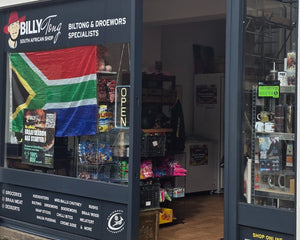
By the 2000s and 2010s, dedicated biltong producers and South African food shops began appearing across the UK. Brands like Billy Tong emerged to fill the gap — offering traditionally made, award-winning biltong to both the expat community and an increasingly curious British audience. Our shop in Cobham, Surrey, became a gathering point for local South Africans and a discovery spot for British neighbours drawn in by the unfamiliar, irresistible aroma of air-drying meat.
Going Mainstream: Biltong’s Rise in British Culture
What started as an expat niche has become a genuine mainstream trend. Several factors have driven biltong’s rise in the broader UK market:
The high-protein movement. As more Brits have embraced protein-focused diets — whether for gym performance, weight management, or general health — biltong has emerged as one of the cleanest, most convenient high-protein snacks available. With 50–60 g of protein per 100 g and minimal carbohydrates, it fits perfectly into the macro-tracking culture that has exploded in the UK over the past decade.
Keto and low-carb diets. The ketogenic diet, carnivore diet, paleo, and Whole30 have all grown substantially in the UK. Biltong’s near-zero carb content makes it one of the most keto-friendly snacks on the market — and word has spread fast through fitness communities and social media.
Clean eating and ingredient awareness. British consumers are reading labels more carefully than ever. The simplicity of traditional biltong — beef, vinegar, salt, and spices — resonates with people who are tired of processed snacks packed with additives, sugars, and E-numbers.
Rugby and sport. South Africa’s Springboks rugby team has an enormous following, and the cultural exchange between South African and British rugby communities has helped introduce biltong to a wider sporting audience. Billy Tong is proud to have supplied biltong to the Springboks — a connection that reflects just how deeply this snack is tied to South African sporting culture.
Social media and word of mouth. Once people try biltong, they tend to talk about it. Social media posts, gym recommendations, and office sharing have created a powerful organic word-of-mouth effect that continues to drive new customers to the product.
A Timeline of Biltong: Key Moments in 400 Years
|
Period
|
Milestone
|
|
Pre-1600s
|
Indigenous Khoikhoi and San peoples dry strips of game meat in the southern African sun — an ancient preservation technique.
|
|
1652
|
The Dutch East India Company establishes a settlement at the Cape of Good Hope. Dutch settlers combine European vinegar-curing with local drying methods.
|
|
Late 1600s–1700s
|
Biltong recipes take shape as Cape colonists refine the use of vinegar, salt, coriander, and pepper to preserve beef and game.
|
|
1830s–1840s
|
The Great Trek. Voortrekker families carry biltong as essential survival rations on their mass migration into the South African interior.
|
|
1880–1902
|
Biltong sustains Boer commandos during the Anglo-Boer Wars, becoming a symbol of Afrikaner resilience and self-sufficiency.
|
|
20th century
|
Biltong transitions from rural survival food to a beloved national snack, with commercial producers and biltong shops appearing across South Africa.
|
|
1990s–2000s
|
Large-scale South African emigration brings biltong culture to the UK. Expats create demand for commercially produced biltong in Britain.
|
|
2010s
|
Biltong enters the UK mainstream, driven by the high-protein movement, keto diets, clean-eating trends, and growing availability in shops and online.
|
|
2020s
|
Biltong is widely recognised as a leading high-protein snack in the UK. Award-winning producers like Billy Tong serve both the expat community and a new generation of British biltong fans.
|
How Biltong Is Made Today: Tradition Meets Quality
Despite four centuries of history, the fundamental process of making biltong has changed remarkably little. The best modern producers — Billy Tong included — still follow the core principles established by those early Cape settlers: quality beef, a vinegar-and-spice marinade, and patient air-drying in a controlled environment.
What has changed is the level of quality control. At Billy Tong, we select premium cuts of beef (primarily silverside and topside), season them with our traditional spice blend, and air-dry them in purpose-built drying rooms where temperature, humidity, and airflow are carefully monitored. The result is a product that honours the centuries-old tradition while meeting the highest modern standards for food safety, consistency, and flavour.
For a step-by-step look at how the process works, read our detailed guide: How Is Biltong Made? A Step-by-Step Look at Traditional Air-Drying.
Why the History of Biltong Matters
You might be thinking: it’s a snack — why does the history matter? Because biltong isn’t just a product. It’s a connection to centuries of human ingenuity, cultural tradition, and the simple desire to make food that lasts, nourishes, and tastes extraordinary.
When you tear open a pack of Billy Tong biltong, you’re eating something made using essentially the same method that sustained Voortrekkers on the Great Trek, fuelled Boer soldiers in wartime, and brought comfort to generations of South African families at braais, rugby matches, and kitchen tables. That’s a heritage worth knowing about — and worth preserving.
At Billy Tong, we take that heritage seriously. Our biltong is made in the traditional way, with simple ingredients and genuine craftsmanship. It’s why we won the LUX Magazine award for Best Authentic Biltong Provider — and it’s why South African expats and British converts alike keep coming back.
Frequently Asked Questions
Where does biltong come from?
Biltong originates from South Africa, where Dutch settlers in the 17th century developed the technique of vinegar-curing and air-drying meat to preserve it for long journeys. The method combined European curing knowledge with indigenous African drying practices.
Who invented biltong?
Biltong as we know it was developed by Dutch settlers (later known as Boers) at the Cape of Good Hope from the mid-1600s onwards. They adapted existing European and African meat-preservation techniques into the vinegar-and-spice curing method that defines biltong today. See our post 'What is Biltong? The Complete Beginner's Guide'
How old is biltong?
The biltong-making tradition dates back over 400 years to the mid-17th century, though the underlying techniques of drying and curing meat are far older. Indigenous southern African communities were drying meat long before European settlers arrived.
Why is biltong so popular in South Africa?
Biltong is deeply woven into South African culture. It began as a practical survival food for long treks and wartime, and over centuries it became the snack of choice at braais, rugby matches, road trips, and family gatherings. For South Africans, biltong is comfort food and national identity rolled into one.
When did biltong come to the UK?
Biltong arrived in the UK primarily through South African emigration from the 1990s onwards. As the expat community grew, so did demand for commercially made biltong. By the 2010s, it had crossed into the British mainstream as a popular high-protein snack.
Is biltong the same as jerky?
No. Biltong and beef jerky are made using fundamentally different methods. Biltong is air-dried using a cold process with vinegar and spices, while jerky is heat-dried or smoked and often contains added sugars. The result is a different taste, texture, and nutritional profile. For a full comparison, see our guide: Biltong vs Beef Jerky: What’s the Real Difference?
What is biltong made of?
Traditional biltong is made from quality beef (usually silverside or topside), vinegar, coarse salt, cracked black pepper, and ground coriander. Some recipes add small amounts of brown sugar or additional spices, but the core ingredient list is remarkably short and simple.
Taste 400 Years of Tradition
Now you know the story — the next step is to taste it. Explore Billy Tong’s premium biltong collection and experience a snack that’s been perfected over four centuries. Award-winning, traditionally air-dried, and delivered to your door anywhere in the UK. Shop now at billytong.com
New to biltong? Start with our Original Biltong for the classic South African flavour, or try a Taster Bundle to discover your favourite.
Want to explore more of South Africa’s food culture? Browse our droëwors, boerewors, and South African grocery range — everything you need to bring a taste of the Rainbow Nation home.